





The Ultimate 2026 Guide: Mastering Off Grid Hybrid Solar Inverters for Total Energy Independence
Discover the ultimate 2026 guide to mastering off-grid hybrid solar inverters. Learn how to size your system, understand the differences between hybrid and off-grid models, and leverage the latest AI and MPPT technologies for total energy independence.
- What is an Off Grid Hybrid Solar Inverter?
- Key Takeaways: Quick Summary of Hybrid Solar Systems
- Hybrid vs. Off-Grid Inverters: Understanding the Real Differences
- Future-Proofing: Essential Features to Look for in 2026 Models
- Sizing Your System: Battery Backup and Inverter Capacity
- Expert Tips & Common Mistakes to Avoid in Installation
- Industry Leading Solutions: Real-World Energy Independence
- Conclusion
- Can a hybrid inverter work completely off-grid?
- What is the main difference between an off-grid and hybrid inverter?
- Do I need batteries for a hybrid solar inverter to work?
- How many solar panels can a 5kW hybrid inverter handle?
- What does dual MPPT mean on a hybrid inverter?
- How long do hybrid solar inverters typically last?
- Can I use a gas generator with an off-grid hybrid inverter?
- What is the average cost of a high-quality hybrid inverter in 2026?
What is an Off Grid Hybrid Solar Inverter?
An off grid hybrid solar inverter is an advanced energy management system that combines a solar charge controller, a battery inverter, and grid-assist capabilities. It seamlessly routes bidirectional power between solar panels, battery storage, and utility lines for continuous electricity.
Beyond merely acting as a bridge between your panels and your house, this technology represents a massive leap forward in automated power routing. A premium pure sine wave hybrid inverter constantly analyzes the energy demands of your property in real time. If your solar panels are producing more electricity than your home is consuming, the system directs the surplus energy into an all-in-one energy storage system to charge your battery bank. Conversely, if a severe storm rolls in and solar production drops, the inverter intelligently supplements the power shortage by drawing from the batteries or automatically connecting to the utility grid. This seamless transition happens in mere milliseconds, meaning your lights will not flicker and your sensitive computers will not crash. Ultimately, it simplifies your entire installation by housing complex power conversion technology inside a single, elegant unit.
- All-in-One Integration: Combines multiple critical components into one streamlined, easy-to-install chassis.
- Continuous Electricity: Seamlessly routes bidirectional power during grid outages to act as an uninterruptible power supply.
- Grid-Assist Capabilities: Intelligently supplements temporary power shortages with utility energy or generator input.
- Battery Management: Automatically regulates sophisticated charging cycles to maximize the lifespan of your storage bank.
Key Takeaways: Quick Summary of Hybrid Solar Systems
Hybrid solar systems offer the ultimate flexibility by operating both independently of and in tandem with the utility grid. They are meticulously designed to maximize solar self-consumption, eliminate net-metering reliance, and provide scalable energy security for modern off-grid residential applications.
The push toward 100% energy independence has transformed the solar industry. Modern consumers are no longer satisfied with standard grid-tied systems that automatically shut down during neighborhood blackouts. By investing in hybrid technology, homeowners secure complete control over their power generation. You can operate in tandem with the utility grid to take advantage of low overnight electricity rates, or disconnect entirely to run as an independent microgrid. This ensures continuous power availability regardless of external infrastructure failures. Furthermore, these systems are specifically engineered to maximize your solar self-consumption, heavily reducing or completely eliminating your reliance on outdated net-metering policies that financially favor utility companies over homeowners.
- Ultimate Flexibility: Operate both independently of and in tandem with the utility grid depending on daily weather conditions.
- Maximized Efficiency: Designed to prioritize solar self-consumption and eliminate costly net-metering reliance.
- Scalable Expansion: Modern units support plug-and-play expansion, allowing users to parallel multiple units for whole-home backup.
- Advanced Chemistry: Seamless integration with LiFePO4 lithium batteries is standard, offering unmatched longevity and fire safety.
Hybrid vs. Off-Grid Inverters: Understanding the Real Differences
The primary difference when comparing a hybrid solar vs off grid inverter is that off-grid models operate completely independently of utility lines, whereas hybrid inverters can intelligently synchronize with the grid to pull backup power or export excess solar energy.
Choosing the right architecture requires a deep understanding of your long-term energy goals. Dedicated off-grid inverters are engineered strictly for remote isolation—places like mountain cabins, telecommunication towers, or rural farms where utility poles simply do not exist. Because they are unidirectional, they cannot interact with the commercial power grid. If your batteries run dry, your only backup is a noisy, fuel-hungry gas generator. In contrast, a hybrid unit is fully bidirectional. According to the foundational definition of a photovoltaic conversion unit, as reported by Wikipedia, stand-alone inverters operate strictly independently, whereas advanced hybrids have the unique capability to synchronize with commercial electrical grids. This means a hybrid system can draw cheap overnight grid power to top off your batteries before a major hurricane hits, providing unparalleled peace of mind.
- Power Flow Mechanisms: Bidirectional (hybrid) versus unidirectional (off-grid) power conversion mechanisms.
- Remote Constraints: Dedicated off-grid limitations are prevalent in remote environments without any utility access.
- Utility Synchronization: Hybrid flexibility offers lucrative net metering benefits, grid-shaving, and peak-load shifting.
- Financial Return: Comparing upfront installation costs against long-term energy savings and improved grid stability.
Future-Proofing: Essential Features to Look for in 2026 Models
Future-proof 2026 solar inverters feature AI-driven smart load shedding software, high-voltage PV inputs exceeding 550V, and robust environmental protections. These advanced hardware specifications ensure maximum energy yield and optimal battery preservation regardless of extreme weather events or fluctuating grid conditions.
As global energy demands shift, the hardware you install today must be capable of handling the smart-home requirements of tomorrow. One of the most important features to demand in a modern unit is a dual MPPT charge controller. This advanced technology allows the inverter to independently track and optimize two entirely separate strings of solar panels. If a large oak tree shades the eastern side of your roof, the western array will continue producing at maximum capacity. This optimization relies on sophisticated mathematical algorithms, as reported by Wikipedia, which continually adjust the electrical load to extract the absolute peak power available under changing environmental conditions. Furthermore, built-in artificial intelligence now manages smart load shedding, proactively turning off non-essential circuits (like pool pumps) to preserve critical battery life during extended blackouts.
- Smart Preservation: AI-driven smart load shedding software for optimized battery life preservation.
- String Efficiency: High-voltage PV inputs (550V+) allowing for longer, more efficient and cost-effective solar panel strings.
- Maximized Yield: Dual and triple MPPT trackers maximize yield across varying roof angles and shading conditions.
- Weather Resilience: Robust environmental protections like IP66 waterproof ratings for extreme weather survival.
Sizing Your System: Battery Backup and Inverter Capacity
Properly sizing your solar system requires accurately calculating your continuous home load demand against temporary motor surge capacity. You must also determine the correct battery bank size in kilowatt-hours to meet your specific days of autonomy and backup power requirements.
Sizing is arguably the most critical step in designing a reliable energy storage solution. It is not enough to simply calculate your average daily power consumption; you must account for the massive temporary power spikes required to start inductive motors, such as air conditioners, well pumps, and large refrigerators. For larger American homes requiring 240V power for these heavy appliances, installing a 48v split phase solar inverter is absolutely essential to natively deliver both 120V and 240V alternating current without the severe efficiency losses of external transformers. Additionally, you must decide how to couple your energy sources. The decision between AC and DC coupling drastically alters your system's efficiency, as reported by the National Renewable Energy Laboratory, because DC-coupled systems route power directly from the PV array to the batteries, preventing the energy loss associated with multiple AC-to-DC conversions.

- Load Calculations: Calculating your continuous home load demand versus temporary motor surge capacity.
- Storage Autonomy: Properly sizing your battery bank (in kWh) for your desired days of autonomy.
- System Architecture: Understanding AC versus DC coupling architecture for maximum system efficiency.
- Phase Output: Choosing between single-phase (120V) and split-phase (120V/240V) systems for heavy inductive appliances.
Expert Tips & Common Mistakes to Avoid in Installation
The most critical expert tips for inverter installation involve correctly sizing DC wire gauges to prevent dangerous voltage drops, and ensuring proper closed-loop communication between the inverter and the battery management system for safe, efficient, and long-lasting system operation.
Even the highest quality hardware will suffer catastrophic failures if installed incorrectly. At Guangzhou Congsin Electronic Technology Co., Ltd., we have over 27 years of focused experience manufacturing professional power solutions. Founded in 1998, our engineering teams have overseen the deployment of over 100+ specialized models globally, utilizing advanced instrumentation and multifunctional testing equipment. Based on our extensive internal data, undersizing DC cables is the number one cause of system overheating and efficiency loss. Heavy currents flowing from a 48V battery bank require appropriately rated, thick copper wiring to minimize resistance. Additionally, when integrating our advanced Inverter Series with modern lithium batteries, establishing a digital closed-loop communication link (CAN or RS485) is non-negotiable. This data connection allows the battery's internal computer to dictate precise charging voltages to the inverter, ensuring maximum safety and preventing thermal runaway.
- Mistake: Undersizing DC wire gauges, leading to severe voltage drops, inefficiencies, and potential overheating.
- Tip: Ensure proper closed-loop communication setup between the inverter and battery BMS (CAN/RS485).
- Mistake: Overlooking the cold start function specifications required for reliable operation in harsh winter environments.
- Tip: Always prioritize firmware updates immediately after initial commissioning to ensure optimal smart load functionality.
Industry Leading Solutions: Real-World Energy Independence
Industry-leading hybrid solar solutions achieve real-world energy independence by providing seamless automatic transfer switching and integrating generator auto-start functionalities. These premium systems ensure absolute zero interruption to critical continuous loads, such as sensitive medical equipment or remote agricultural facility operations.
Transitioning to a fully independent power setup is a proven commercial reality that demands rigorous reliability. Leveraging our fully automated production lines, Congsin has successfully deployed highly customized energy solutions across Europe, the Americas, the Middle East, Africa, and Southeast Asia. Because our manufacturing process is ISO9001 certified, every unit meets strict international compliance standards, including CE, FCC, RoHS, and ETL. One of our recent case studies highlights the transition of a remote agricultural facility to total grid independence. By utilizing a premium hybrid setup equipped with Auto Generator Start (AGS) capabilities, the facility’s vital water pumps and ventilation fans remained perfectly operational during a severe multi-day grid blackout. The intelligent inverter automatically fired up the backup diesel generator only when solar reserves dropped to critical levels, seamlessly conserving fuel while maintaining absolute fail-safe reliability.
- Agricultural Independence: Transitioning a rural agricultural facility to total grid independence using a premium hybrid inverter setup.
- Zero Interruption: Providing seamless automatic transfer switching with zero interruption to critical medical or server loads.
- Fail-Safe Reliability: Integrating modern generator auto-start (AGS) functionalities for true fail-safe reliability.
- Global Deployment: Meeting diverse international compliance standards to guarantee operational safety across different harsh climates.
Conclusion
Mastering the implementation of off grid hybrid solar inverters is the ultimate step toward complete energy independence. These systems offer robust protection against unpredictable utility failures while ensuring long-term financial savings through highly optimized and intelligent daily power consumption management.
By carefully selecting a system equipped with the appropriate surge capacity, advanced dual MPPT tracking features, and 2026-ready AI software integrations, you are making a long-term investment in a resilient power supply designed to last for decades. Whether you are constructing an off-grid cabin in the mountains or future-proofing a suburban home against increasingly common rolling blackouts, the right hybrid hardware bridges the gap between unreliable utility grids and true energy sovereignty. The path to complete self-reliance begins with understanding your unique power needs and implementing hardware capable of seamless, automated energy management.
Contact us today to optimize your off grid hybrid solar inverter strategy.
Can a hybrid inverter work completely off-grid?
Yes, hybrid inverters can operate entirely off-grid by drawing power directly from solar panels and battery storage banks without relying on utility grid connections.
What is the main difference between an off-grid and hybrid inverter?
Off-grid inverters operate completely independently of the utility grid, while hybrid inverters can synchronize with the grid to pull backup power or export excess solar energy.
Do I need batteries for a hybrid solar inverter to work?
While some hybrid models support battery-less operation by acting like grid-tied inverters during the day, you must have a battery bank to maintain power during nighttime or grid outages.
How many solar panels can a 5kW hybrid inverter handle?
A 5kW hybrid inverter can typically handle between 12 to 16 standard 400W solar panels, provided the total wattage and voltage do not exceed the inverter's maximum PV input limits.
What does dual MPPT mean on a hybrid inverter?
Dual MPPT (Maximum Power Point Tracking) allows the inverter to independently manage two separate arrays of solar panels, which is ideal for roofs facing different directions or experiencing varying shade.
How long do hybrid solar inverters typically last?
High-quality hybrid solar inverters are designed to last between 10 to 15 years, with premium brands offering warranties extending up to 10 years when installed properly in climate-controlled environments.
Can I use a gas generator with an off-grid hybrid inverter?
Yes, most modern off-grid hybrid inverters include generator input ports with AGS (Auto Generator Start) capability, allowing the inverter to automatically fire up the generator when batteries drop below a specific voltage.
What is the average cost of a high-quality hybrid inverter in 2026?
In 2026, depending on the phase support and capacity (typically 5kW to 15kW), a high-quality hybrid inverter ranges from $1,200 for budget models up to $6,500 for premium, high-capacity all-in-one units.
How to Size a 24V Pure Sine Wave Inverter for Your System
Affordable High-Efficiency Solar Inverters for Homes
How High Frequency Inverters Improve Power Density and Efficiency
How to Size a 2000W Inverter for Home Backup and Appliances
Pure Sine Wave Inverters
What is the difference between labeled 6000W and full power 3000W?
Labeled 6000W is peak power, which is only used to cope with the instantaneous high-power demand during device startup (such as air conditioner, motor startup); full power 3000W is continuous power, referring to the power that the device can stably output for a long time. When driving appliances daily, 3000W should be used as a reference to avoid total power overload.
Modified Sine Wave Inverters
Can it be used with a car cigarette lighter socket?
Yes, it supports both battery clip and cigarette lighter connection.
Which country’s voltage standards does it support?
It defaults to AC 220V output, suitable for regions with 220V voltage standards such as China and Europe; it can also be customized to output AC 110V, suitable for regions with 110V voltage standards such as the United States and Japan.
How many devices can it power at the same time?
Dual universal sockets + two USB ports can power multiple devices (such as two home appliances + two mobile phones) at the same time, as long as the total power does not exceed 600W.
OEM & ODM Services
Do you provide support for shipping and customs clearance?
Yes, we offer international logistics solutions including export documentation and customs advice.
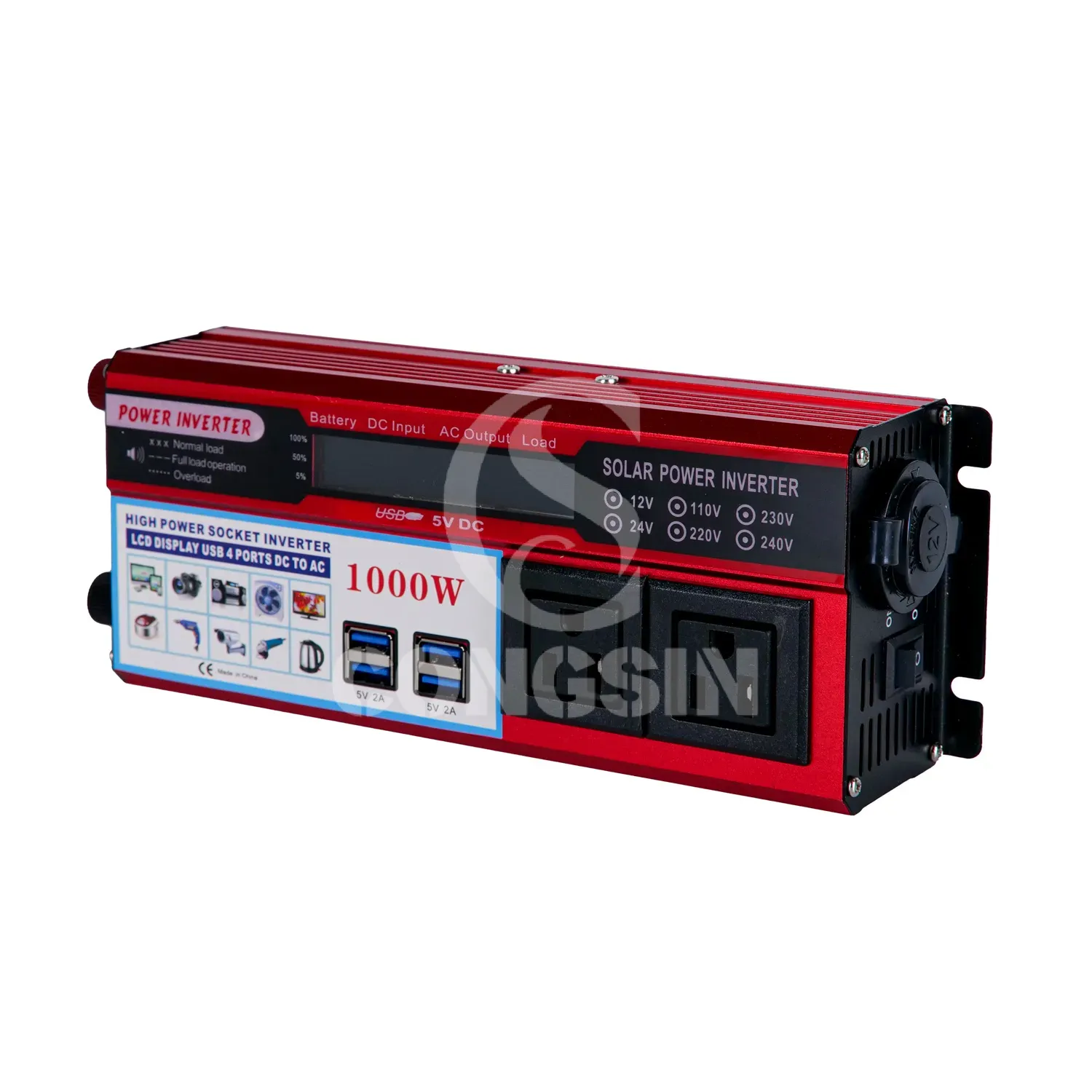
Congsin 1000W modified sine wave inverter with American Sockets and Lcd display portable 12V car RV
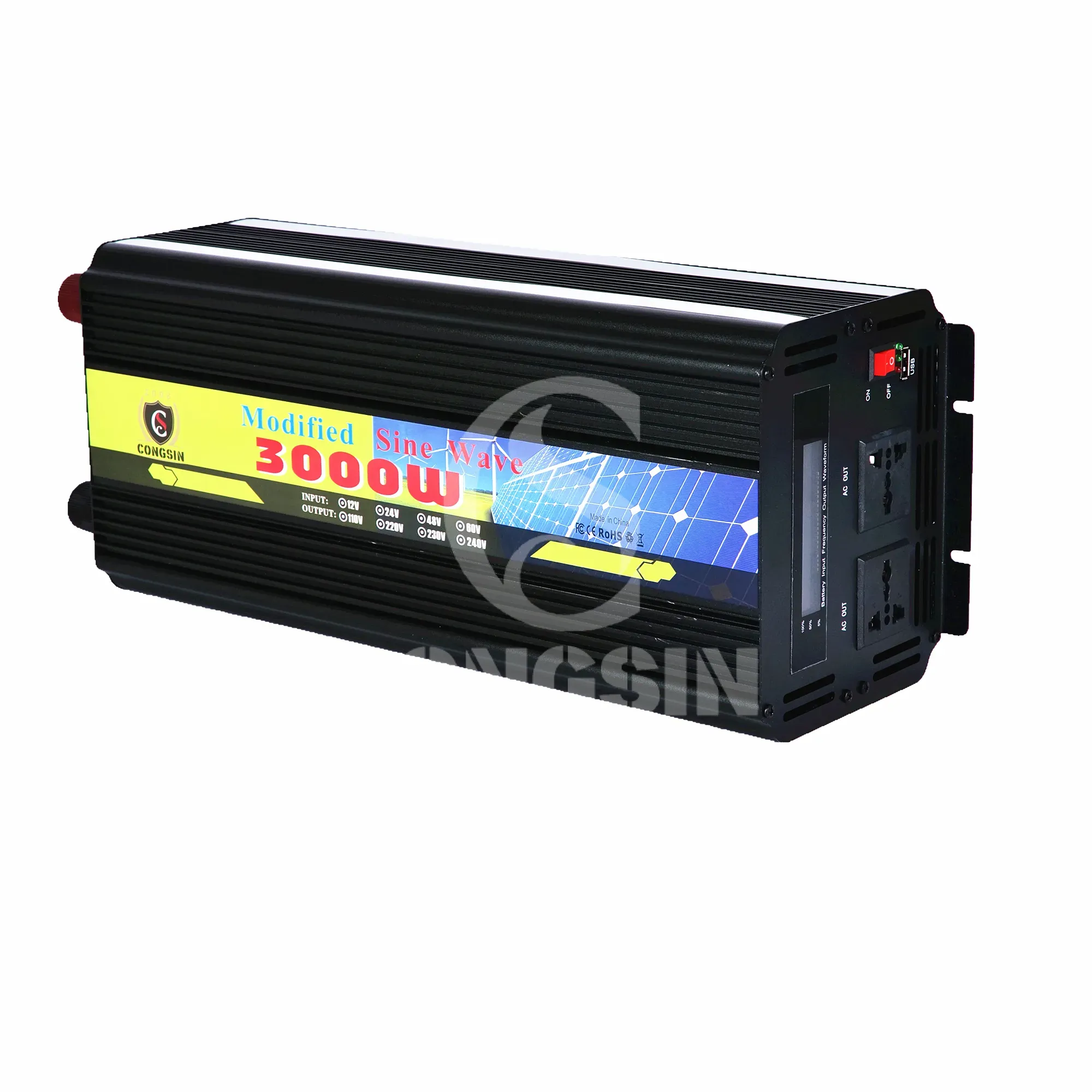
Congsin Full Power 3000W Modified Sine Wave Inverter Peak Power 6000W with LCD Display RV Solar
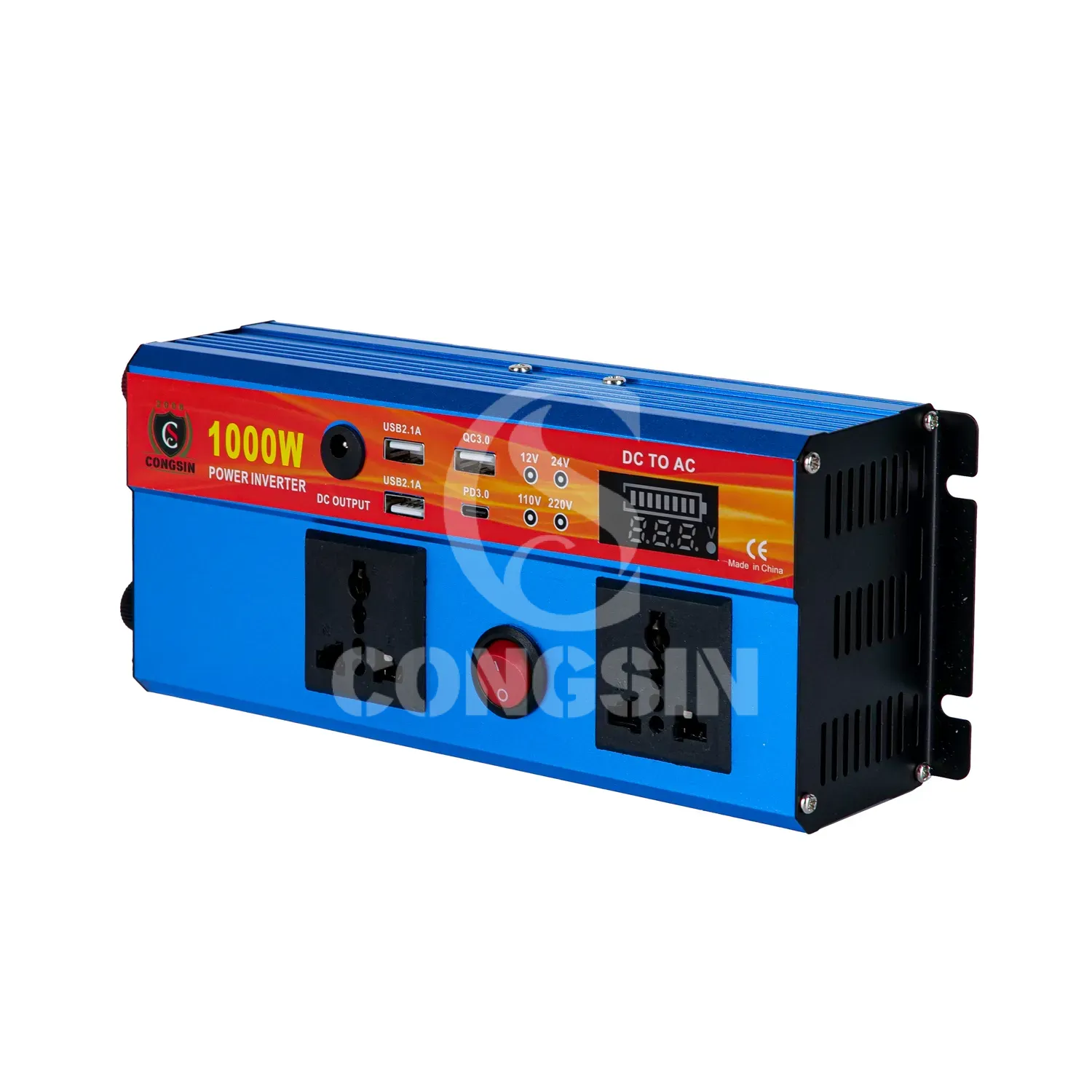
Congsin 1000W modified sine wave inverter with LED display and Type C port car RV power inverter
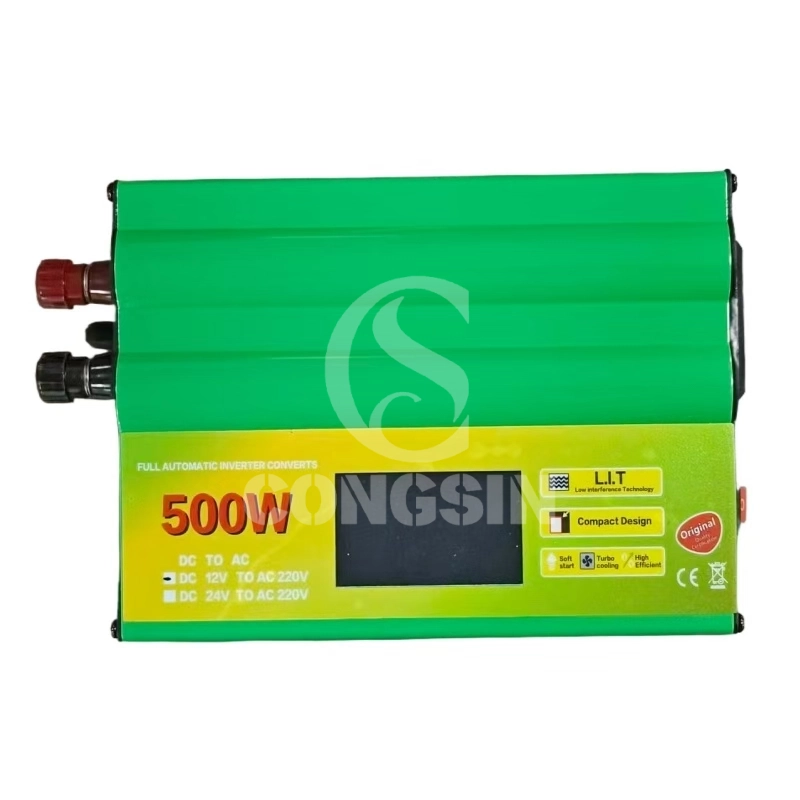
Congsin Modified Sine Wave Inverter 500W 1000W 1500W 12V LED Display Portable for RV Car Solar

CONGSIN is a trusted OEM factory for power inverters, solar charge controllers, and DC converters. Reliable solutions for global B2B buyers.
 High Quality
 7/24 Service
 Guaranteed Warranty
© 2025 Congsin. All Rights Reserved.